
The Letter of Intent - M&A Basics
1. Executive Summary: What Is a Letter of Intent?
In any M&A transaction, the Letter of Intent — commonly referred to as an LOI — is the document that sets the stage for everything that follows. Before due diligence begins, before attorneys draft the purchase agreement, and before any money changes hands, there is the LOI. It is a preliminary agreement between a buyer and seller that outlines the major terms of a proposed transaction: the purchase price, the structure of the deal, what assets and liabilities are included, and the conditions under which both parties agree to proceed.
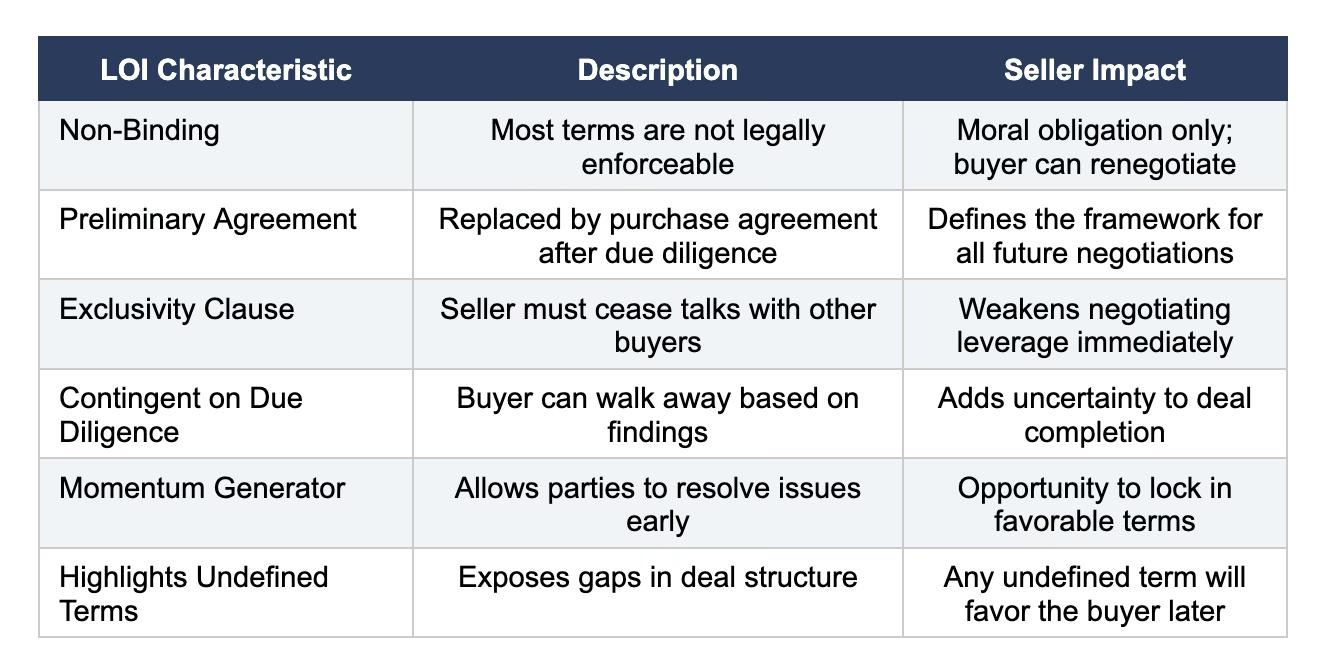
While most LOIs are intentionally non-binding — meaning neither party is legally obligated to complete the transaction — they carry enormous practical weight. Once signed, an LOI typically triggers an exclusivity period during which the seller agrees to stop negotiating with other buyers and take the business off the market. This single clause fundamentally shifts the balance of power in the negotiation.
The LOI is also a preliminary agreement that will eventually be replaced by the definitive purchase agreement. Its purpose is to allow both parties to move into the due diligence phase without incurring the significant legal costs of preparing a full purchase agreement at a stage when the deal has not yet been confirmed. Think of it as an engagement ring before the wedding — it signals serious intent without completing the transaction itself.
Understanding the LOI in full detail is essential for any seller looking to protect their interests and maximize the value of their business. Below is a summary of the major characteristics that define an LOI and shape the negotiation dynamics.
2. Why the LOI Matters More Than the Purchase Agreement
Most sellers underestimate the LOI. They see it as a stepping stone — a formality on the path to the real agreement. Experienced buyers know better, which is precisely why they often rush sellers toward signing one. The moment an exclusivity clause takes effect, the seller's negotiating power largely evaporates.
Here is the dynamic that unfolds in practice: a sophisticated buyer may be negotiating with multiple sellers simultaneously, while you — as the seller — are in exclusive talks with a single buyer. The asymmetry is significant. If you walk away from the deal after signing an LOI and attempt to re-engage other buyers, those buyers will assume something went wrong. They will conduct more rigorous due diligence and likely lower their valuation as a result.
Savvy buyers also understand that the longer a seller is engaged in the process, the more emotionally and financially invested they become. Legal fees accumulate. Management attention is consumed. By the time a buyer begins "chipping" at the price during due diligence — citing unexpected findings or overstated EBITDA — many sellers simply lack the stamina to restart negotiations with a new party.
The LOI is also where the purchase agreement gets its DNA. Any term left undefined in the LOI will almost certainly be drafted in the buyer's favor when the purchase agreement is prepared — and it is almost always the buyer's attorney who drafts that document. The first draft sets the tone, and an undefined term is an open invitation for the buyer to claim what they want.
The bottom line is this: you have maximum leverage before you sign the LOI. Use it. Do not be pressured by artificial urgency. The time to define terms, negotiate protections, and lock in favorable conditions is now — not after exclusivity has been granted.
3. Is the Letter of Intent Legally Binding?
The short answer is: mostly no, but with important exceptions. Most LOIs are deliberately drafted to be non-binding, which is appropriate given that the buyer has not yet had the opportunity to conduct due diligence and verify the seller's representations. The price, working capital adjustments, deal structure, escrow terms, and most other commercial terms are typically non-binding.
However, several provisions within an LOI are intentionally drafted to be legally binding and enforceable:
- Exclusivity: The seller's agreement to cease negotiations with other buyers during a defined period.
- Confidentiality: Both parties' obligation to protect sensitive information shared during the process.
- Due Diligence Access: The buyer's right to review books, records, and key personnel.
- Earnest Money Deposit: Where applicable, whether any deposit is refundable or non-refundable.
- Expenses: Allocation of costs if the deal does not proceed to closing.
Courts have taken varying approaches to LOIs. While a clear statement of non-binding intent is generally upheld, courts have in some cases found implied obligations — particularly a duty to negotiate in good faith — even without an explicit clause. This has practical relevance when dealing with a competitor who may be using the due diligence process to extract proprietary information.
A well-drafted LOI will clearly label which provisions are binding and which are not — either in the document's introduction, within each section, or in a concluding summary paragraph. A common error is to declare the entire LOI non-binding without carving out the provisions that must be enforceable. This oversight can create legal ambiguity and undermine the very protections that binding clauses are meant to provide.
4. Key Contents of a Letter of Intent
While LOIs vary in length and complexity depending on the size and nature of the transaction, there is a core set of terms that should appear in virtually every well-drafted LOI. These include:
- Purchase price and the structure of consideration (cash, notes, earnout, equity rollover)
- Assets and liabilities included in the transaction, with particular attention to working capital
- Legal form of the transaction — asset sale versus stock sale
- The seller's ongoing role post-closing, including any employment or consulting arrangements
- Conditions to closing, such as financing contingencies or regulatory approvals
- The scope and timeline of the due diligence process
- Exclusivity period length and any milestone requirements
- Deadlines and transaction milestones to keep the process moving forward
Less commonly but still importantly, an LOI may also address escrow or holdback amounts, earnest money deposits, confidentiality obligations, the allocation of purchase price among assets, and preliminary representations and warranties. The more of these terms that are pinned down in the LOI, the more protected the seller will be throughout the remainder of the process.
The introductory section of an LOI is often largely ceremonial — expressing the buyer's enthusiasm and outlining high-level intentions. However, sellers should read this section carefully. Some buyers embed advantageous language in the preamble that can later be used to anchor a position in negotiations. Clarity is always in the seller's interest; ambiguity nearly always benefits the buyer.
5. Understanding Purchase Price and Payment Terms
The purchase price clause is, on its face, the most important part of the LOI. But the headline number alone is rarely the full story. The "true" or "net" purchase price depends heavily on what is — and is not — included in that figure. Buyers and sellers frequently arrive at very different interpretations of the same number because of how assets, liabilities, and working capital are treated.
Consider two scenarios. In the first, the purchase price is $10 million, which includes $2 million in working capital. The seller receives $10 million at closing. In the second scenario, the purchase price is also stated as $10 million — but working capital is excluded, meaning it is purchased separately. The seller actually receives $12 million at closing. The headline number is identical; the economic outcome is vastly different.
This is why sellers must read every element of the purchase price clause with care — not just the number itself, but what is included and excluded, how working capital is defined and calculated, and how the price will be paid. The LOI should clearly itemize the form of consideration:
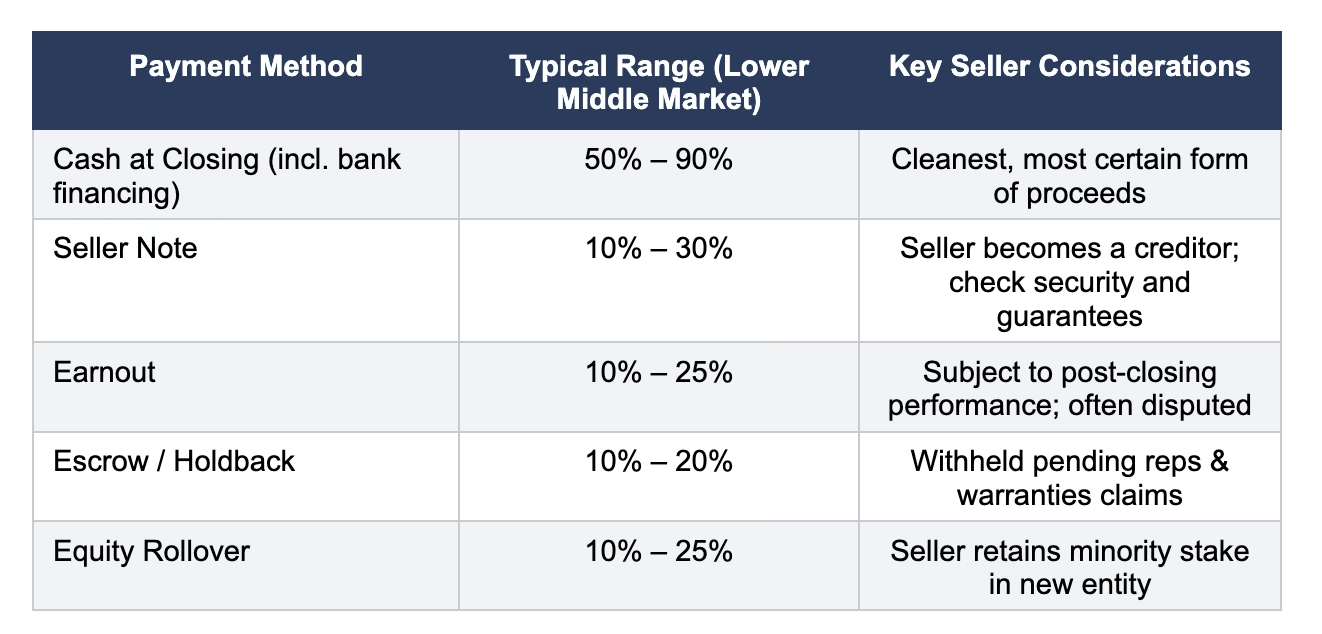
Each non-cash component of the purchase price introduces risk and uncertainty. Seller notes depend on the buyer's ability to pay. Earnouts are notoriously difficult to collect and frequently disputed. Escrows can be eroded by indemnification claims. Before accepting an LOI, sellers should stress-test the total consideration across realistic scenarios — not just the best case.
6. Fixed Price vs. Formulas and Ranges: What Sellers Should Know
The ideal LOI defines the purchase price as a fixed dollar amount — for example, $10 million. This removes ambiguity and gives both parties a firm baseline for the transaction. Price ranges and formula-based valuations, on the other hand, introduce subjectivity and almost always resolve in the buyer's favor.
A price range in an LOI — such as "$8 million to $12 million, subject to due diligence findings" — might appear to offer upside potential. In practice, sellers consistently find themselves at the lower end of the range. If you cannot get the buyer to commit to a fixed price, at minimum request that they be given access to additional financial information before signing the LOI, so they can sharpen their offer.
Formula-based pricing, such as a multiple of trailing twelve-month EBITDA, introduces further complications. EBITDA is never a purely objective figure — there are legitimate accounting judgments embedded in every income statement. Buyers who structure offers as a formula will frequently revisit their EBITDA assumptions during due diligence, often discovering that EBITDA was "overstated" and revising the price downward. If a formula is unavoidable, ensure that it works symmetrically — meaning if EBITDA is found to be higher than initially represented, the purchase price also increases accordingly.
Also be wary of formulas that include a price cap. A cap tells you the maximum you can receive regardless of performance, but it rarely comes with a corresponding floor. Protect yourself by negotiating the formula to be two-directional and by defining all key terms — particularly EBITDA and how it is calculated — with as much specificity as possible in the LOI itself.
7. Working Capital: The Hidden Deal Variable
Of all the terms that catch sellers off guard in M&A transactions, working capital adjustments are among the most consequential. Working capital — defined broadly as current assets minus current liabilities, encompassing accounts receivable, inventory, prepaid expenses, accounts payable, short-term debt, and accrued expenses — can represent a significant portion of a business's total value. Yet many sellers never think to negotiate how it is treated in the LOI.
Corporate buyers, in particular, almost universally structure their offers to include working capital in the purchase price. This means the headline number already assumes a certain level of working capital will be delivered at closing. If actual working capital at closing falls below the agreed target, the purchase price is reduced. If it exceeds the target, the seller may receive additional consideration — but only if the mechanism is structured symmetrically, which requires explicit negotiation.
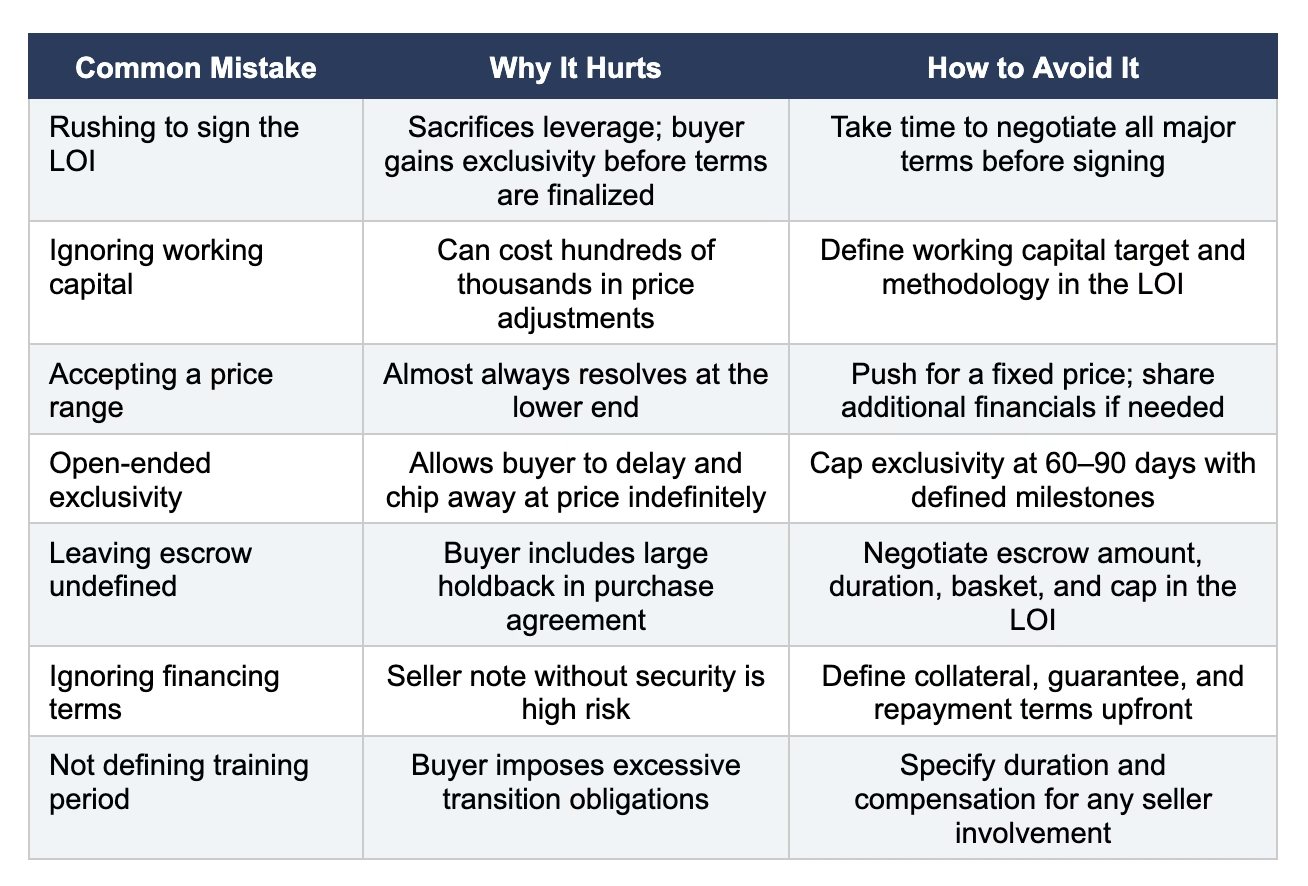
Leaving working capital undefined in the LOI is a costly mistake. Not only will the buyer define it later in the purchase agreement — in their own favor — but the definition of what counts as working capital, how it is calculated, and what the target balance should be will all be determined at a point when the seller's leverage has been exhausted. The potential financial impact can be substantial: for mid-sized businesses, working capital adjustments can swing the net proceeds by hundreds of thousands — or even millions — of dollars.
The following assets are generally included in the purchase price in most transactions: furniture, fixtures, and equipment; vehicles; leasehold improvements; intellectual property; business records and customer lists; and any training and transition periods. Real estate, long-term debt, and the seller's legal entity (in asset sales) are typically excluded. Working capital items — accounts receivable, inventory, and payables — should be explicitly addressed in the LOI with a clear target and a defined calculation methodology.
8. Exclusivity, Escrow, and Other Critical Clauses
Exclusivity
The exclusivity clause is among the most consequential provisions in any LOI, and also one of the most frequently overlooked by sellers who are eager to move forward. Once you grant exclusivity, you are contractually prohibited from negotiating with other buyers for the duration of the exclusivity period. Your ability to create competitive tension — the most powerful tool in any seller's arsenal — disappears entirely.
Most exclusivity periods range from 30 to 90 days, though some buyers propose open-ended exclusivity that lasts "as long as the parties are negotiating in good faith." This type of clause is a serious red flag. A less scrupulous buyer can use an open-ended exclusivity period to delay indefinitely, slowly eroding the purchase price while the seller has no other options. At minimum, exclusivity should be limited to a specific number of days with clearly defined milestones — for example, a requirement that the buyer submit a draft purchase agreement within 30 days, or that financing approval be obtained within 45 days. Failure to meet these milestones should automatically terminate exclusivity.
Escrow and Holdback
Many LOIs fail to mention an escrow or holdback at the term sheet stage, only for the seller to encounter a significant holdback provision buried deep in the draft purchase agreement — at a point when they have little leverage to push back. An escrow or holdback typically represents 10% to 20% of the purchase price and is held for a period of 12 to 24 months after closing to cover potential indemnification claims arising from breaches of representations and warranties.
If an escrow is going to be part of the transaction, define it in the LOI. Negotiate the amount, the duration, the basket (the minimum threshold of claims before the escrow can be drawn upon), and the cap (the maximum total liability). These terms are far easier to negotiate before exclusivity is granted than after.
Earnout
Earnouts — where a portion of the purchase price is paid after closing based on the business's future performance — deserve their own extensive treatment. For sellers, earnouts represent both opportunity and risk. They allow a buyer to bridge a valuation gap by offering potential upside tied to post-closing results. In practice, however, earnouts are notoriously difficult to collect. Post-closing disputes about how revenue or EBITDA is calculated, what expenses are allocated to the business, and whether management decisions impaired performance are common — and expensive — to resolve.
If an earnout is a component of the deal, the LOI should define the metric, the measurement period, the payment timeline, and any caps on the total earnout amount. The LOI should also address what operational protections the seller has post-closing to ensure the business is managed in a way that gives the earnout a fair chance of being achieved.
9. Common Mistakes Sellers Make — and How to Avoid Them
The most dangerous mistakes in an M&A transaction are often made at the LOI stage, not during the drafting of the purchase agreement. Here are the most frequent errors and how to protect against each:
10. Sample LOI Language and Clause Examples
Understanding how LOI provisions are drafted in practice is invaluable for sellers. Below are examples of both simple and detailed purchase price clauses — illustrating how much complexity can be embedded in a single section of the LOI.
Simple Purchase Price Clause
"Buyer will acquire 100% of the common stock of Seller for total consideration equal to $15,000,000, plus adjustments for Cash, Indebtedness, and Net Working Capital."
While straightforward on its surface, this clause leaves significant room for interpretation. How is Net Working Capital defined? What constitutes "Indebtedness"? These ambiguities will be resolved later — in the buyer's favor.
Detailed Purchase Price Clause
A more protective clause for the seller might read as follows: "Purchase Price: $7,000,000 on a cash-free, debt-free basis, with working capital paid as an additional payment at closing. A capped earnout equal to 10% of revenue above $8.5 million for five years, measured annually and paid within 60 days of each period end, with a total aggregate cap of $1,500,000. A working capital advance of $900,000 paid at closing, with the remaining outstanding amount reconciled four months post-closing based on actual collections. Accounts receivable not collected within four months are held until resolution. Inventory to be valued at cost in accordance with historical accounting practices. The working capital payment excludes pre-paids and work-in-progress. Payment structure: $250,000 good faith deposit at LOI signing; $2,000,000 at purchase agreement execution; $500,000 working capital advance at closing; remaining working capital reconciled at four months; 10% equity rollover into the acquiring entity."
Notice how the detailed clause specifies calculation methodology, timing, exclusions, and the equity component — each of which eliminates a potential dispute point downstream. This level of specificity is what separates a seller-protective LOI from a standard one that leaves the buyer free to draft the purchase agreement on their own terms.
11. Conclusion: Use Your Leverage While You Have It
The Letter of Intent is the most consequential document in most M&A transactions — not because it is legally binding, but precisely because it is not. The terms you define in the LOI become the baseline for everything that follows. The terms you leave undefined will be filled in by the buyer's attorneys, in the buyer's favor, at a time when you have no leverage left to push back.
Sellers who take their time at the LOI stage — who resist the pressure to sign quickly, who insist on defining working capital, exclusivity periods, escrow terms, and earnout mechanics — consistently achieve better outcomes than those who rush forward in a spirit of momentum and goodwill. Buyers count on that goodwill. It is not cynical to say so; it is simply how the process works.
The good news is that the tools to protect yourself are available. Negotiate the LOI with the same rigor you would apply to the purchase agreement. Define the terms that matter. Limit the exclusivity period and attach milestones to it. Understand what working capital target is embedded in the offer. And if an earnout or seller note is on the table, ensure the mechanics are clear before you sign anything.
Once you have a well-structured LOI in hand, move quickly. Due diligence is where deals die of inertia. The goal from LOI signing forward is to reach the closing table with the terms you negotiated intact — and that starts with getting those terms right at the very beginning.
12. Frequently Asked Questions (FAQs)
Q1. What is the main purpose of a Letter of Intent in an M&A transaction?
The LOI serves as a preliminary agreement that outlines the major terms of a proposed transaction — including the purchase price, deal structure, and conditions to close — before the parties invest in formal due diligence or the preparation of a definitive purchase agreement. It establishes a shared framework and reduces the risk that the parties will disagree on fundamental deal terms later in the process.
Q2. Is a Letter of Intent legally enforceable?
In most cases, no. The commercial terms of an LOI — including the purchase price, working capital adjustments, and deal structure — are generally non-binding. However, several provisions are typically drafted to be legally enforceable, including the exclusivity clause, confidentiality obligations, and any earnest money deposit terms. Courts may also impose a duty to negotiate in good faith even when the LOI is otherwise non-binding.
Q3. Why do buyers rush sellers to sign the LOI?
Experienced buyers understand that the seller's negotiating leverage diminishes significantly the moment an exclusivity clause takes effect. By rushing a seller to sign the LOI, a buyer limits the seller's ability to negotiate terms, create competitive tension with other buyers, or walk away without significant cost. Every day of exclusivity is a day of leverage the buyer has and the seller does not.
Q4. What happens to terms that are not defined in the LOI?
Any term left undefined in the LOI will be drafted in the purchase agreement — typically by the buyer's attorney — in a manner that favors the buyer. This includes working capital targets, escrow amounts, earnout mechanics, training period obligations, and dozens of other commercial provisions. The adage holds: if it is not in the LOI, assume the worst.
Q5. How long should the exclusivity period be?
Most exclusivity periods in lower middle-market transactions range from 30 to 90 days. As a seller, you should resist open-ended exclusivity clauses and insist on a fixed duration with clearly defined milestones — such as a requirement that the buyer deliver a draft purchase agreement within a specified number of days, or that financing approval be secured within a set timeframe. Failure to meet milestones should trigger the automatic termination of exclusivity.
Q6. What is working capital, and why does it matter in an LOI?
Working capital is generally defined as current assets minus current liabilities, encompassing accounts receivable, inventory, prepaid expenses, accounts payable, short-term debt, and accrued expenses. For corporate buyers, working capital is almost always included in — or pegged to — the purchase price. If the actual working capital at closing differs from the agreed target, the price is adjusted accordingly. These adjustments can be significant, which is why the working capital definition and target must be clearly established in the LOI.
Q7. What is an earnout, and what are the risks for sellers?
An earnout is a deferred payment mechanism in which a portion of the purchase price is paid after closing based on the business meeting defined performance metrics — typically revenue or EBITDA targets over a one- to five-year period. While earnouts can help bridge valuation gaps, they are frequently disputed post-closing. Sellers should negotiate the measurement metrics, accounting methodology, operational protections, and payment mechanics in detail before signing any LOI that includes an earnout component.
Q8. Should the purchase price in an LOI be a fixed number or a range?
A fixed purchase price is almost always preferable from the seller's perspective. Price ranges consistently resolve at the lower end in practice. If a buyer cannot commit to a fixed price, consider providing them with additional financial detail so they can firm up their offer before the LOI is signed. Formula-based pricing — such as a multiple of EBITDA — introduces further subjectivity and should be avoided or very carefully structured if it cannot be eliminated entirely.
Q9. What is the difference between an escrow and a holdback?
In M&A transactions, these terms are often used interchangeably. Both refer to a portion of the purchase price — typically 10% to 20% — that is withheld at closing and held by a third-party escrow agent or the buyer for a defined period (commonly 12 to 24 months) to cover potential indemnification claims arising from breaches of the seller's representations and warranties. The key negotiating points are the amount held, the duration of the hold period, the threshold of claims required before the escrow can be accessed (the basket), and the maximum total liability (the cap).
Q10. Why is the LOI considered more important than the purchase agreement?
Although the purchase agreement is the legally definitive document in an M&A transaction, it is largely a product of the LOI. The terms defined in the LOI establish the baseline from which the purchase agreement is drafted. By the time the purchase agreement is being negotiated, the seller has signed away exclusivity, invested significantly in the process, and has very little leverage remaining. The LOI is where the real negotiation happens — and where the outcome of the deal is largely determined.