
What Is My Online Casino Actually Worth?
The 5 Metrics That Drive Valuation in 2026 - Published by BuySellCasino.com | February 2026
The global online gambling market surpassed $130 billion in 2025 and is on course to exceed $143 billion in 2026, growing at a compound annual rate of roughly 10%. Deal activity in the iGaming sector has never been more intense: from Flutter Entertainment's full acquisition of FanDuel to Intralot's €2.7 billion takeover of Bally's International Interactive, 2025 was a landmark year for iGaming mergers and acquisitions.
Against this backdrop, one question lands in our inbox at BuySellCasino.com more than any other: What is my online casino actually worth?
The honest answer is that casino valuation is part science, part art — and the gap between what sellers believe their business is worth and what the market will pay for it is often significant. Understanding how sophisticated buyers assess value is the single most powerful thing you can do before listing your asset.
This guide breaks down the five key metrics that will define your casino's valuation in 2026, with benchmark data, formulas, and practical advice on how to move the needle before you go to market.
1. Why Casino Valuation Is Different in 2026
Most business owners assume their company is worth a simple multiple of annual revenue or EBITDA. In iGaming, that assumption will leave money on the table — or worse, cause a deal to collapse at due diligence.
Online casinos carry a distinctive risk-reward profile that separates them from almost every other digital business. Player databases can evaporate overnight if a major payment processor relationship breaks down. A regulatory change in a single jurisdiction can remove 40% of your revenue in a quarter. Conversely, a casino with a loyal, high-LTV player base operating under a Tier-1 license in a newly regulated market can command eye-watering multiples.
According to analysis of 77 public gambling and casino companies in 2024, the median EV/EBITDA multiple for the sector sits at approximately 6.1x — with premium digital-pure-play operators often trading significantly above that floor. Major iGaming M&A deals in 2025 have demonstrated that strategic buyers will pay 10x-15x EBITDA or more when the right conditions align: strong recurring revenue, clean compliance records, Tier-1 licensing, and defensible organic traffic.
Key Insight: In 2026, buyers aren't just buying your revenue — they're buying your regulatory position, your player relationships, and your risk profile. All three need to be in strong shape to unlock premium valuation.
2. Metric #1 — GGR and NGR
Gross Gaming Revenue (GGR) and Net Gaming Revenue (NGR)
GGR is the bedrock of any online casino valuation. It represents total player wagers minus total winnings paid — in other words, the raw revenue the house generates before any costs are taken out. NGR goes a step further, stripping out player bonuses, promotional costs, payment provider fees, and applicable taxes to reveal what the business actually retains.
The formula is straightforward: GGR = Total Wagers – Winnings Paid Out. NGR then deducts bonus costs, provider fees, and applicable gaming taxes from GGR.
Why does this distinction matter for valuation? Because a casino showing impressive GGR numbers but a collapsing NGR margin is signalling a structural problem — usually over-reliance on bonusing to retain players or rising platform costs eroding the real economics. Buyers conduct intensive NGR analysis because it is the truest measure of operating profitability before overhead.
Benchmark Data for 2026
A year-over-year GGR growth rate of 10-15% is considered strong and will support a premium valuation multiple. Promotional costs that exceed 20% of GGR are a yellow flag for buyers — it suggests the business is burning bonus budget to sustain numbers that don't reflect organic health. A monthly ARPU (Average Revenue Per User) of $100–$200 is generally regarded as a healthy benchmark for mid-market online casinos.
One critical tactical point before listing: get your last 24 months of GGR and NGR data organised into a clean monthly tracker with variance explanations. Buyers will ask for this within hours of signing an NDA, and the quality of your financial data room will directly influence both the speed and certainty of closing.
Buyer Perspective: Consistently growing NGR with promotional costs below 20% of GGR tells a buyer this is a well-managed, financially disciplined operation. That discipline is priced into the multiple.
3. Metric #2 — Player Lifetime Value (LTV) and Churn Rate
The Economics of Your Player Base
If GGR tells buyers how much money the house is making today, Player Lifetime Value (LTV) tells them how much the relationship with each player is worth over time. It is one of the most scrutinised metrics in any iGaming acquisition, and one of the most commonly miscalculated by sellers.
The core formula is: LTV = ARPU × Average Player Lifespan. For example, if your average monthly revenue per player is €50 and your average active lifespan is 14 months, your LTV is €700 per player.
Critically, LTV should be calculated at the cohort level — broken down by acquisition channel, game preference, and geography. A casino where SEO-acquired players generate an LTV of €700 while paid social players generate only €120 is a fundamentally different business than one where channels perform consistently. Sophisticated buyers will stress-test your LTV figures against your churn data, and any mismatch will slow or kill a deal.
Churn Rate: The Metric Sellers Underestimate
Churn rate — the percentage of active players who become inactive within a defined period — is the silent killer of casino valuations. A monthly churn rate above 5% signals that the business is on a treadmill: constantly spending acquisition budget just to replace players who are leaving, rather than building genuine equity in a loyal base.
Industry benchmarks suggest that a 30-day player retention rate of 70-80% is the mark of a well-run operation. Buyers will model out your player database decay curve and use it to project forward revenues under their own operational assumptions. A clean, segmented CRM with rich behavioural data — deposit frequency, session length, preferred verticals — dramatically strengthens your negotiating position because it reduces buyer uncertainty.
Valuation Lever: An LTV-to-CAC ratio of 3:1 or higher, combined with a monthly churn rate below 5%, can add 1-2x turns to your EBITDA multiple at exit.
4. Metric #3 — Traffic Quality and Organic Channel Mix
Not All Traffic Is Created Equal
Traffic is the lifeblood of an online casino, but its source matters enormously in a valuation context. A casino generating 80% of its new player registrations through paid media — PPC, affiliate cashback deals, and paid social — is a fundamentally riskier business than one where 60% of registrations come from organic search and direct traffic. The former is buying growth; the latter has built it.
Buyers in 2026 will interrogate your traffic breakdown with forensic detail. Google's continued algorithm updates have made organic iGaming rankings harder to sustain than ever, meaning a casino with genuine SEO authority — real Domain Rating, editorial backlinks, content depth — commands a meaningful premium. Proprietary, diversified traffic is an asset that cannot be replicated quickly, and buyers price that scarcity.
What Buyers Look For in 2026
The rise of AI-driven player acquisition and first-party data strategies is reshaping traffic valuation. With third-party cookies effectively phased out, casinos that have invested in server-to-server tracking, first-party identity management, and CRM-led re-engagement programmes are valued more highly than those still dependent on third-party affiliate data architectures.
Mobile traffic quality is also under the microscope. Industry data shows that approximately 72% of online gambling activity now occurs on mobile devices, with Europe generating 58% of its online gambling revenue through mobile platforms. A casino with a sub-3-second mobile load time, a native app presence, and strong App Store ratings will achieve a materially higher multiple than a desktop-first operation.
SEO traffic over 60% of total traffic = significant valuation premium
Affiliate dependency over 50% = risk flag, likely EBITDA adjustment by buyers
Strong App Store presence + mobile-first UX = 10-15% multiple uplift
First-party data infrastructure = future-proofed, commands strategic premium
2026 Trend: Buyers are increasingly pricing in AI and personalisation capabilities. Casinos with AI-driven bonus optimisation and real-time player segmentation are attracting a new tier of strategic acquirers willing to pay above-market multiples.
5. Metric #4 — EBITDA and Revenue Multiples
The Language of Professional Casino Buyers
When institutional buyers, private equity funds, and strategic acquirers evaluate an online casino, the conversation always centres on EBITDA — Earnings Before Interest, Tax, Depreciation, and Amortisation. It is the universal language of deal-making because it provides a leverage-neutral, tax-neutral view of operating cash generation.
In the broader gambling and casino industry, analysis of public comparables shows a median EBITDA margin of approximately 25% and a gross margin of around 52%. These figures provide a useful reality check: a casino generating €5 million in GGR with properly controlled costs should be generating €1.2 million or more in EBITDA. If it isn't, buyers will want to understand why before pricing the multiple.
Current Market Multiples for 2026
In the mid-market iGaming M&A space — casinos with €500K to €5M in annual EBITDA — typical acquisition multiples range from 6x to 10x EBITDA. Premium assets with Tier-1 licensing, strong organic traffic, and clean compliance histories can achieve 10x-15x. Strategic transactions involving market entry or technology acquisition can exceed these benchmarks significantly, as evidenced by major 2025 deals.
It is important to note that private market transactions typically apply a 20-30% Discount for Lack of Marketability (DLOM) relative to public market comparables. Sellers who understand this going in will negotiate more effectively.
A practical way to think about your baseline: EBITDA × 6 = floor value; EBITDA × 10-12 = strong asset premium. Everything above that requires a strategic rationale.
Pro Tip: Sellers who present a clean, adjusted EBITDA with clear add-backs (one-off legal costs, founder salary adjustments, non-recurring tech spend) consistently achieve better outcomes than those presenting unadjusted P&L data. Prepare your normalised EBITDA statement before engaging any buyer.
6. Metric #5 — Licensing Jurisdiction and Regulatory Standing
Your License Is Part of Your Balance Sheet
In 2026, perhaps no single factor shapes online casino valuation more than licensing jurisdiction. The regulatory landscape has never been more complex or more consequential — and buyers know it.
A Malta Gaming Authority (MGA) license or a UK Gambling Commission (UKGC) license does not just represent compliance; it represents market access, payment processor relationships, bank account stability, and brand trust. These are assets with intrinsic value. Conversely, a Curacao-only operation may generate strong revenue but will face significant buyer discounting due to regulatory risk, payment processing constraints, and exclusion from key regulated markets.
Jurisdiction Premium in 2026
The opening of new regulated markets is one of the biggest value drivers in iGaming right now. New Zealand's new online gambling licensing regime, Brazil's formalised federal framework under Law No. 14,790/2023 which came into force in early 2025, and continued expansion of US state-level iGaming are all creating asymmetric valuation opportunities. A casino with existing operational experience — technology, payment infrastructure, player acquisition expertise — in a newly opened market commands extraordinary strategic value to buyers seeking rapid market entry.
Tier-1 licensed operations in established regulated markets typically command a 20-40% valuation premium over equivalent revenue businesses operating under offshore or Tier-3 licenses. Clean compliance records with no Advertising Standards violations, AML audit issues, or pending regulatory investigations are table stakes for any credible M&A process.
MGA (Malta) — Globally respected; premium for EU market access
UKGC (United Kingdom) — Highest compliance bar; commands top-tier multiple
Kahnawake / Curacao — Discount applied; buyer risk adjustment likely 20-30%
New regulated markets (Brazil, New Zealand, US states) — Strategic premium for market-ready operators
7. The Valuation Snapshot: Key Metrics at a Glance
The table below summarises the five core valuation metrics, their benchmarks, and their relative impact on sale price. Use this as a quick diagnostic tool when assessing your own operation.
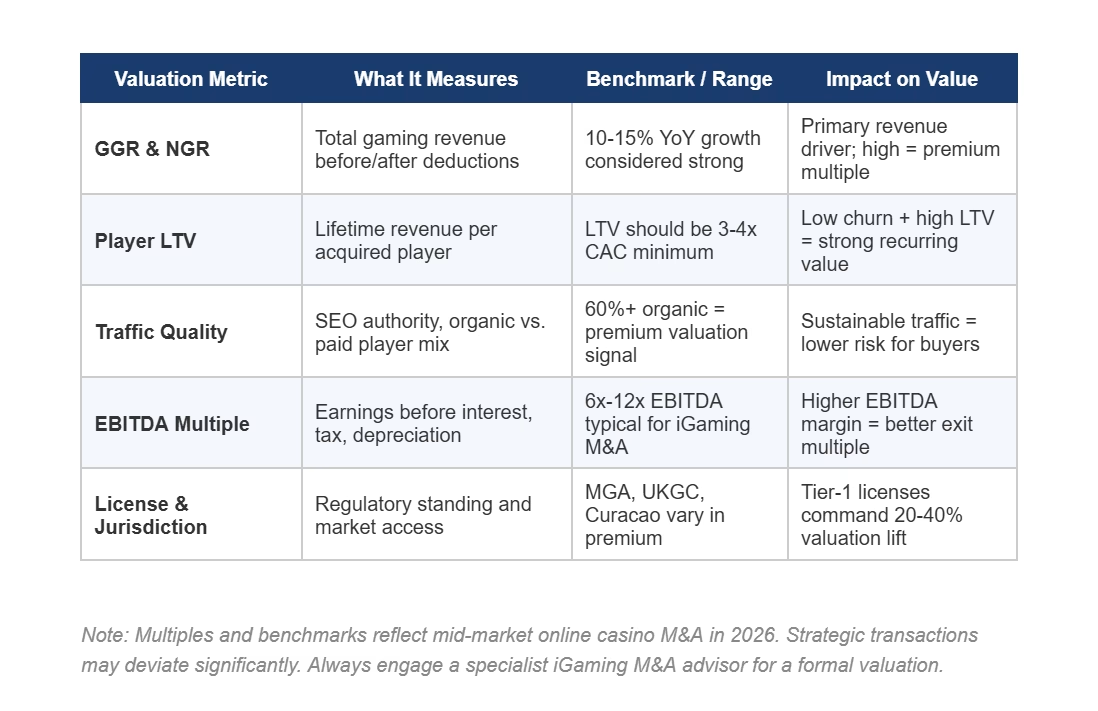
Note: Multiples and benchmarks reflect mid-market online casino M&A in 2026. Strategic transactions may deviate significantly. Always engage a specialist iGaming M&A advisor for a formal valuation.
8. How to Increase Your Casino's Value Before Selling
Knowing the metrics is only half the battle. The other half is actively improving them before going to market. Here are the highest-leverage actions operators can take in the 12-18 months before a planned exit:
Clean Up Your Financial Reporting
Buyers want 24-36 months of clean, monthly P&L data with GGR, NGR, EBITDA, and key operational metrics clearly separated. If your accounting is currently a single consolidated figure, invest in proper management accounting immediately. The clarity and confidence it creates in a buyer's mind is worth multiples of the cost.
Invest in Organic Traffic
If your casino is overly dependent on paid acquisition channels, begin a structured SEO and content programme now. Even 12 months of compound organic growth can materially shift your traffic mix — and your exit multiple. Editorial authority takes time to build but it is among the highest-ROI pre-sale investments an operator can make.
Strengthen Your Compliance Infrastructure
Buyers will conduct full KYC/AML audits. Any gaps — undocumented source-of-funds procedures, inconsistent responsible gambling checks, outstanding regulatory correspondence — will either kill deals or trigger significant price reductions. Proactively addressing compliance gaps before going to market puts you in the strongest possible negotiating position.
Upgrade Your CRM and Data Infrastructure
Rich player behavioural data is currency in an M&A process. Buyers want to see cohort analysis, LTV by acquisition channel, retention curves, and VIP segmentation. If your CRM is currently a basic email platform, upgrade it. The story your data tells about player economics is often the difference between a standard multiple and a premium one.
9. Frequently Asked Questions
What is the typical EBITDA multiple for an online casino sale in 2026?
For mid-market online casinos — those generating between €500K and €5M in annual EBITDA — typical multiples range from 6x to 10x EBITDA. Premium assets with Tier-1 licensing, strong organic traffic, and clean compliance histories can achieve 10x-15x or higher, particularly when a strategic buyer is acquiring for market access or technology rather than purely for financial return.
Does the choice of gaming license affect my casino's sale price?
Significantly. A Malta Gaming Authority (MGA) or UK Gambling Commission (UKGC) license typically commands a 20-40% valuation premium over equivalent businesses operating under Curacao or other offshore licenses. This is because Tier-1 licenses provide payment processor stability, access to regulated advertising markets, and a level of due diligence clarity that materially reduces buyer risk.
How is player LTV calculated for M&A purposes?
The standard formula is LTV = ARPU × Average Player Lifespan, where ARPU is the average net gaming revenue generated per active player per month. For M&A purposes, buyers will typically want LTV broken down by acquisition channel and player segment. An LTV-to-CAC ratio of at least 3:1 is the general benchmark buyers use to assess whether the player acquisition model is sustainable and scalable.
Should I use GGR or NGR as my primary valuation metric?
Both matter, but NGR is the more honest indicator of business health. GGR shows the scale of gaming activity on your platform; NGR shows what you actually retain after bonuses, provider fees, and taxes. Buyers will base their EBITDA calculations on NGR-derived figures, so it is important to understand both metrics and to manage the gap between them — ideally keeping bonus and promotional costs below 20% of GGR.
How long does an online casino M&A process typically take?
From first conversation to completed transfer of funds and assets, a well-structured casino sale typically takes 3-9 months depending on the complexity of the licensing transfer, the depth of buyer due diligence, and the negotiation of reps and warranties. Sales involving MGA or UKGC license transfers tend to be longer due to regulatory approval timelines. Proper preparation of your data room before going to market is the single most effective way to compress this timeline.
What are the biggest deal-killers in casino acquisitions?
The most common issues that collapse casino deals at the due diligence stage include: undisclosed regulatory correspondence or AML investigations, bonus abuse at scale that artificially inflates GGR, murky or undocumented affiliate agreements, technical dependencies that make the platform hard to migrate, and a player database with poor data hygiene — particularly around KYC compliance. Addressing these proactively before listing is strongly advisable.
Is now a good time to sell an online casino?
Market conditions in 2026 are broadly favourable for sellers. M&A activity in iGaming reached record levels in 2025, with major transactions across every segment of the market. The continued expansion of regulated markets globally is creating a new wave of strategic buyers seeking assets that provide operational expertise or market access. However, rising regulatory compliance costs and tightening payment processing conditions mean the gap between premium and average assets is wider than ever. Well-prepared sellers with strong metrics are in an excellent position; underprepared ones risk leaving substantial value on the table.
Ready to Find Out What Your Casino Is Worth?
Valuing an online casino in 2026 is not a simple exercise, but it is a tractable one for operators who understand the five core metrics: GGR and NGR growth, Player LTV and churn, Traffic quality and organic mix, EBITDA and market multiples, and Licensing jurisdiction and regulatory standing.
The operators who achieve the best outcomes are invariably those who treat their exit as a 12-24 month strategic project — not a transaction that begins when they decide to sell. They clean up their data, build organic equity, fix compliance gaps, and come to market with a compelling, evidence-based case for a premium multiple.
At BuySellCasino.com, buyers and sellers across the iGaming market can find each other and deal directly. You can browse comparable listings, use our free valuation tool or list your business.
List your casino or try our free valuation tool at BuySellCasino.com
© 2026 BuySellCasino.com. All rights reserved. For informational purposes only. Not financial or legal advice.